Written by Alex Ren
Updated on 7 min read
Pokémon card rarity symbols explained: circle, diamond, star, and the gold and silver stars of the modern sets
Quick summaryThe small mark next to the collector number in the bottom corner of a Pokémon card is its rarity: a circle for common, a diamond for uncommon, a star for rare. Modern sets add stars in black, silver and gold to separate the ex cards, the full arts, the illustration rares and the gold cards, and anything numbered above the set total is a secret rare. Here is every mark, what it means, and what it does to the price.

In this article
- The original three: circle, diamond, star
- Holo, reverse holo, and why the symbol does not change
- The words era: EX, GX, V, VMAX, VSTAR, Radiant
- The Scarlet & Violet stars: black, silver, gold
- Secret rares: the number gives them away
- Promos: the black star that is not a rarity
- Japanese cards: letters instead of symbols
- What rarity does to the price, and what it does not
- Frequently asked questions
The rarity mark is the second thing to read on a card after the collector number, because it decides which of several near-identical cards you are holding, and therefore which price applies. The system has three eras: the original three symbols, the era of letters and words on the card (V, VMAX, VSTAR, Radiant), and the current one, where the stars themselves changed colour.
The original three: circle, diamond, star#
| Symbol | Rarity | How many per pack | Price, as a rule |
|---|---|---|---|
| ● Circle | Common | Several in every pack | Cents, apart from a few playable ones |
| ◆ Diamond | Uncommon | A few in every pack | Cents to a euro |
| ★ Star | Rare | One rare slot per pack, shared with everything above | From under a euro to whatever the chase card fetches |
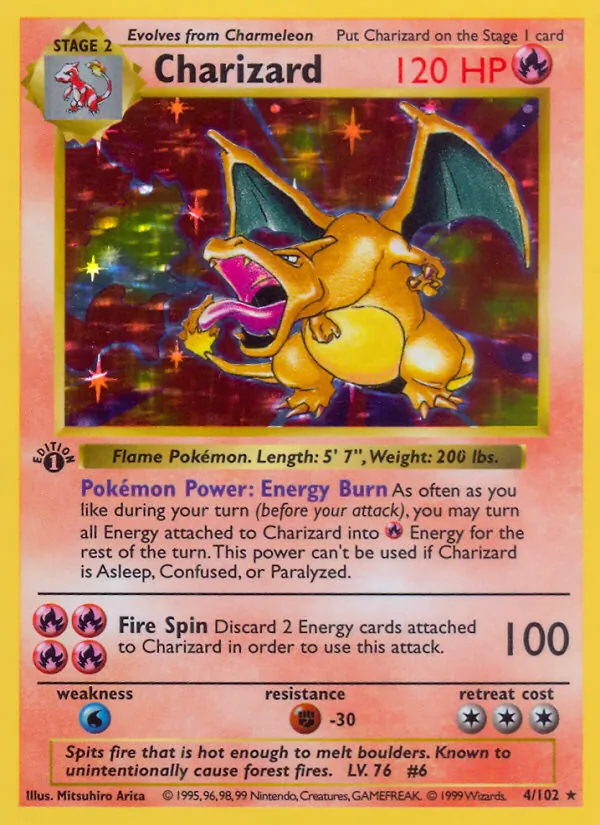
Everything above "rare" also carries a star of some kind, which is why the star alone does not tell you much: a Base Set holographic Charizard and a Base Set non-holo Nidoking both show a star. The finish and, in modern sets, the colour of the star do the rest of the work.
Holo, reverse holo, and why the symbol does not change#
A holo rare has a holographic picture and the same star as a plain rare. A reverse holo has a holographic frame around a flat picture, exists for most commons, uncommons and rares in a set, and keeps whatever symbol its plain version has: a reverse holo common still shows a circle. The symbol tells you the rarity slot the card was printed for; the finish tells you which physical version you hold. Both matter for the price, and catalogues list them as separate cards.
The words era: EX, GX, V, VMAX, VSTAR, Radiant#
From the mid-2010s through the Sword & Shield sets, the top rarities were named on the card rather than in the symbol: cards marked EX, GX, V, VMAX and VSTAR carried a plain star with a word like "Rare Holo V" spelled out at the bottom, Radiant cards used a lettered symbol, and the full-art and rainbow versions were Ultra Rare and Secret Rare, the latter numbered above the set total. If your card says any of those words, its rarity is the word, and the star is just there.
The Scarlet & Violet stars: black, silver, gold#
The Scarlet & Violet sets, from 2023, moved the rarity back into the symbol and gave the stars colours. This is the system on every current pack, and the one that causes the most confusion, because two cards of the same Pokémon can differ only by the number and colour of tiny stars.
| Symbol | Name | What the card looks like |
|---|---|---|
| ★ one black star | Rare | A regular rare, holographic picture |
| ★★ two black stars | Double Rare | The ex cards in their regular frame |
| ★★ two silver stars | Ultra Rare | Full-art Pokémon ex and Trainers, the art covering the card |
| ★ one gold star | Illustration Rare | A common Pokémon in a painted, full-card scene; the most collected tier |
| ★★ two gold stars | Special Illustration Rare | An ex or a Trainer in a painted scene; usually the chase card of the set |
| ★★★ three gold stars | Hyper Rare | The all-gold cards, numbered above the set total |
| ACE SPEC mark | ACE SPEC Rare | The one-per-deck Trainer and Energy cards, with a pink frame |
Secret rares: the number gives them away#
Any card whose first number is higher than the second (say 199/165) is a secret rare, printed beyond the set's official size. In the current era these are the Special Illustration Rares, Hyper Rares and some Ultra Rares; in older sets they were the gold cards, the rainbow cards and the shiny Pokémon. The number, not the star, is the fastest way to spot one across a table.
Promos: the black star that is not a rarity#
A card with a black star containing the word PROMO where the rarity would be is a promotional card, sold in tins, boxes and events rather than packs. Its collector number is a code (SVP followed by a number, or SWSH, or SM) rather than a fraction. Promos are not rare by construction; some are printed in enormous numbers, a few are scarce, and only the catalogue tells you which.
Japanese cards: letters instead of symbols#
Japanese sets print the rarity as letters in the bottom corner, and the ladder is longer: C common, U uncommon, R rare, RR double rare (the ex cards), AR art rare (the equivalent of the Illustration Rare), SR super rare (full arts), SAR special art rare, and UR ultra rare (the gold cards). Older Japanese sets used RRR, HR hyper rare and CHR character rare. The English and Japanese ladders map onto each other, but the prices do not: Japan prints more, so the Japanese version of a modern chase card is usually the cheaper one.
What rarity does to the price, and what it does not#
Rarity sets the supply. It says nothing about demand, which is why a gold Hyper Rare Energy card can be worth less than an Illustration Rare of a popular Pokémon three tiers below it. The rule that holds is: within one set, the top tiers are worth more than the bottom ones; across sets and Pokémon, the character and the artwork decide. Read the rarity to identify the card; read the market to price it.
Join 5,000+ collectors




collection is worth.
The scanner reads the number and the mark, and puts the right rarity and finish on the card before it is priced.
- When two printings are close, holo and reverse, silver stars and gold, the runners-up are on screen and you pick in one tap.
- Each finish is its own card with its own price, drawn from the market data for that exact printing.
- Twenty-five free scans and an unlimited collection by search, on iPhone and Android.
Free to download · iPhone · Android
148/165 · EMBER ASCENT · ★- 0.94
- 0.71
- 0.38
Frequently asked questions
What does the star on a Pokémon card mean?
A star in the bottom corner means the card is rare or above. One black star is a regular rare; in the Scarlet & Violet sets, two black stars mark a Double Rare (ex), two silver stars an Ultra Rare, one gold star an Illustration Rare, two gold stars a Special Illustration Rare and three gold stars a Hyper Rare.
What is the difference between an Illustration Rare and a Special Illustration Rare?
An Illustration Rare (one gold star) is a regular Pokémon drawn in a painted, full-card scene. A Special Illustration Rare (two gold stars) is an ex Pokémon or a Trainer in the same painted style, numbered above the set total, and is usually the most valuable card of the set.
How do I know if a Pokémon card is a secret rare?
Look at the collector number. If the first number is higher than the second, for example 199/165, the card is a secret rare printed beyond the official set size.
What do the letters on Japanese Pokémon cards mean?
They are the rarity: C common, U uncommon, R rare, RR double rare, AR art rare, SR super rare, SAR special art rare and UR ultra rare. They correspond roughly to the English tiers, from Rare through Hyper Rare.