Written by Alex Ren
Updated on 7 min read
First edition, shadowless, unlimited: how to tell the three Base Set prints apart, and why it matters more than the card
Quick summaryAn English Base Set card exists in three prints: 1st Edition, with a black round stamp under the left edge of the picture; shadowless, with no stamp and no drop shadow on the right side of the picture frame; and unlimited, with the shadow. The same card can be worth ten times more as a 1st Edition than as an unlimited print, so this is the first thing to check on any old card before pricing it.

In this article
The famous Charizard is the reason everyone has heard of first editions, but the distinction applies to every card from the first English sets, and most people checking a childhood binder get it wrong in one of two ways: they miss a stamp that is there, or they see "1999" on the card and assume it is a first print. Here is what to look at, in order.
The 1st Edition stamp#
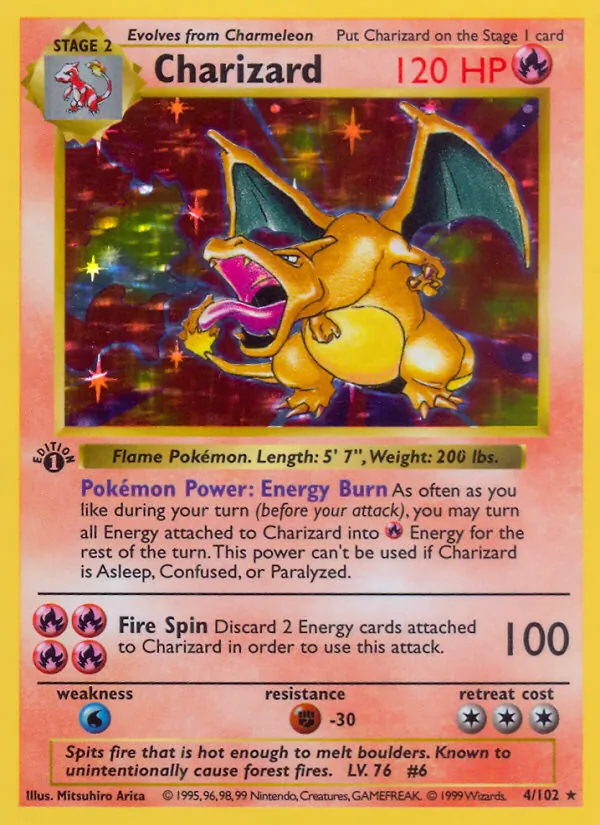
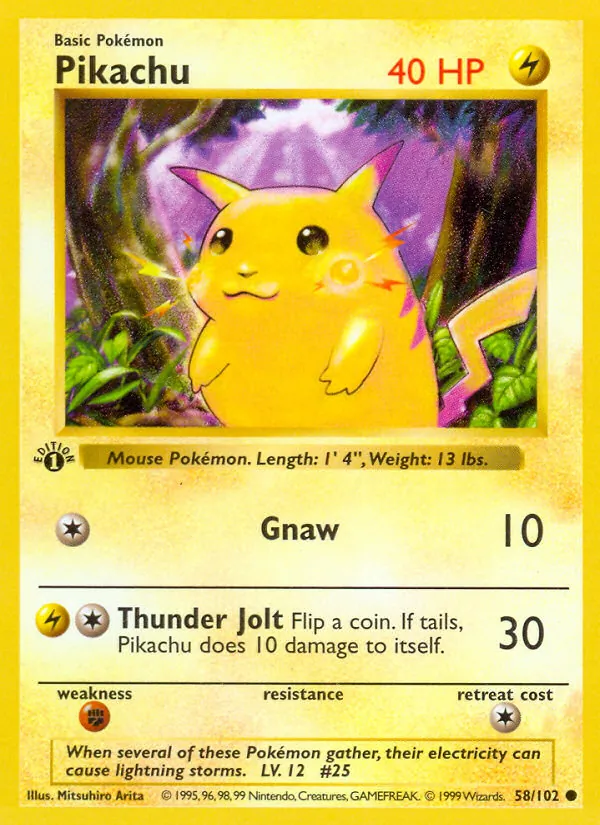
A 1st Edition card carries a small black circle containing a "1" and the word EDITION, printed just below the bottom-left corner of the picture, to the left of the card's stage line. It is on the front, it is black, and it is unmistakable once you know where to look. Wizards of the Coast printed a limited first run of each set with the stamp, from Base Set in January 1999 to Neo Destiny in 2002, and then printed the unlimited run without it. The stamp cannot be added later without being obvious under a loupe, and fakes of it are common on the expensive cards, which is one reason those cards get graded.
Shadowless: the print between the first edition and the rest#
Look at the right-hand edge of the picture frame. On most Base Set cards there is a drop shadow, a thin dark band that makes the frame look raised. On the earliest prints there is none: the frame is flat, and the card is called shadowless. Every 1st Edition Base Set card is shadowless, because the first run used the first layout; after the stamp was dropped, Wizards printed a short run that kept the shadowless layout, and only then moved to the layout with the shadow that everyone recognises.
So a shadowless card without the stamp is the second-rarest print of Base Set, and it is the one most collectors miss, because nothing on it says so. Two more tells confirm it: the HP number and attack text are printed in a thinner, lighter type than on unlimited cards, and the colours of the whole card, especially the red and yellow, are noticeably less saturated.
Unlimited, and the date line that fools everyone#
The unlimited print has the shadow and no stamp, and it was printed in enormous quantities across several runs. The tell between those runs is the copyright line at the bottom of the card: the first unlimited prints read "©1995, 96, 98 Nintendo, Creatures, GAMEFREAK. ©1999 Wizards.", and the last, from the reprint of the set in 2000, read "©1995, 96, 98, 99, 2000". The 1999-2000 line marks the least valuable Base Set print, and it is exactly the one most likely to be in a binder that says "1999" on it.
| Stamp | Shadow on picture frame | Other tells | Relative value | |
|---|---|---|---|---|
| 1st Edition | Yes | No | Thin HP type, muted colours | Highest; the reference for every Base Set price |
| Shadowless | No | No | Thin HP type, muted colours | Well below 1st Edition, well above unlimited |
| Unlimited (1999) | No | Yes | Bold HP type, "©1999 Wizards" line | The standard price for the card |
| Unlimited (1999-2000) | No | Yes | "©1999-2000 Wizards" line | Lowest; the most common print of all |
The other sets: stamp yes, shadowless no#
Shadowless is a Base Set story only. Jungle, Fossil, Team Rocket and the sets through Neo Destiny all have a 1st Edition print with the stamp and an unlimited print without it, in the shadowed layout from the start. The 1st Edition premium in those sets is real but smaller than in Base Set, because the first runs were larger. After Neo Destiny the stamp was retired; there are no 1st Edition cards in the e-Card era or anything later, and a modern card described as "first edition" is either a Japanese "1st Edition" print (Japan used its own stamp in some eras) or a seller's mistake.
What it does to the price#
For the holographic rares, the three prints are three different markets. A 1st Edition holo in top condition is a collector's object whose price is set at auction: the 1st Edition Base Set Charizard in PSA 10 has sold for six figures at the peak, and the other 1st Edition holos for hundreds or thousands in high grades. A shadowless holo of the same card typically sells for a fraction of the 1st Edition and a multiple of the unlimited. The unlimited holo is the one most people own, and it is still a real price for Charizard, Blastoise and Venusaur, in the low hundreds and up depending on condition.
For commons and uncommons, the 1st Edition premium exists but the base is cents, so the stamp turns a card worth nothing into a card worth a little. It is still worth checking, because a full 1st Edition set of the small cards is something collectors pay for as a set.
Condition still comes first#
The print decides which price ladder the card is on; the condition decides where on the ladder it sits, and for these cards the ladder is steep. A 1st Edition holo with a crease is worth less than a shadowless one without, and an unlimited Charizard that has been in a sleeve since 1999 can be worth more than a 1st Edition one that was played with. Before believing any figure, look at the card under a lamp, tilted, and grade it honestly; the same article that explains the condition scales explains where to look up the number for each print.
Join 5,000+ collectors




collection is worth.
The scanner reads the stamp and the layout, and lists the 1st Edition, shadowless and unlimited prints as three cards with three prices.
- Each print is its own entry in the catalogue, priced from the market data for that exact version.
- When the read is close, the candidate picker shows the versions it hesitated between so you choose in one tap.
- Graded prices sit under the raw range where the market publishes them, so the 1st Edition holo you are thinking of sending in can be priced at a 9 and a 10 first.
Free to download · iPhone · Android
Frequently asked questions
How do I know if my Pokémon card is first edition?
Look under the bottom-left corner of the picture for a small black circle with a "1" and the word EDITION. If it is there, the card is 1st Edition. The word "1999" in the copyright line does not mean first edition; every Base Set print carries it.
What is a shadowless Pokémon card?
An early Base Set print with no drop shadow on the right edge of the picture frame, thinner HP type and muted colours. All 1st Edition Base Set cards are shadowless; a shadowless card without the stamp comes from the short run printed after the stamp was dropped and before the shadowed layout was introduced.
Are unlimited Base Set cards worth anything?
The holographic rares are: an unlimited Charizard, Blastoise or Venusaur in good condition sells for real money, and the other holos for less. Commons and uncommons from the unlimited print are worth cents apart from as a complete set.
Do modern Pokémon cards have first editions?
No. The 1st Edition stamp was used on English sets from Base Set (1999) to Neo Destiny (2002) and then retired. Some Japanese sets in other eras carry their own first-print marks, but an English card from 2003 onwards described as first edition is a mistake.